Showing posts with label language. Show all posts

Friday, March 30, 2018

Rules for Talking to Kids about Cancer, Even When the Word ‘Breast’ is Involved

This post is sponsored by Celgene Corporation to review and share information about a new app to help children understand their mother’s breast cancer diagnosis called The Magic Tree. All opinions and thoughts are my own.

How many times have I written in this space about my struggles to come up with the right words to talk to Quinn about cancer? A dozen? Fifty? Do those words even exist? Someday, I will open up to him about the extent of what we thought we were going through and about the trauma we did actually endure. He knows bits and pieces. Someday, I will tell him everything.

He is old enough now to be embarrassed when I talk about breast cancer with others around him. He whispered, “Mom, can you please stop?” when I was talking about the last few years with a new friend – the mom of one of his friends – recently. “Is it because of the word breast?” I asked him. “No, it’s just embarrassing,” he said in the way that kids eventually do about their parents’ actions and stories, and I wonder if he knows what embarrassing really means. But, he is already rolling his eyes at me here and there, so I think that he does. In any case, it makes him uncomfortable to hear me retell my cancer story, at least where someone else, like his friends, might overhear.

Wait until he finds out about this blog.

Navigating cancer treatments with kids at home, and more importantly, figuring out how to keep discussions with them (or conversations when they’re in earshot) age-appropriate is a tricky business. Is a precocious 3-year-old ready for the same information as a more mature and worldly 7-year-old? And, what I always struggled with when I was in treatment and thought my disease was terminal, how do you maintain your child’s innocence and tell him or her you might be dying?

I still don’t know all of the answers about talking to kids about cancer or death, but I have a few.
  1. What rang true again and again in our family was share age appropriate truth, but don’t overshare. 
    • a.  For example, when I was in treatment, Quinn was very young. When he was a toddler, I told him mommy was sick and needed medicine to make her better. But I did not tell him I might die of my sickness. It wasn’t imminent, and I didn’t feel the need to scare him more than necessary. 
  2. Only answer their specific questions. 
    • a.  When Quinn wanted to know why I was losing my hair, I told him the medicine was hurting the cancer inside me, but also sometimes hurt my regular cells, including my hair.
  3. Related: be careful with your language. I didn’t expand to say how terrible I felt or use the word “killing” to explain how chemo was working.
I read to him from pamphlets I picked up at the hospital or books about his love being my best medicine. What all of these lacked, though, was what happened if mommy didn’t get better. I kept that dark knowledge to myself, and – as I’ve documented again and again – cried next to him after the lights went out.

What I wish I’d had in my toolbox is a more interactive and educational way to discuss cancer with Quinn. And now that he doesn’t want to hear about it, I do. Celgene has developed a new app, The Magic Tree, with short videos, a resource library for parents and cooperative games that earn decorations for the in-app tree. You can find links to download it on their web site http://magictreebreastcancer.com.
Quinn is a big fan of the games. One seems rooted in curling, the winter sport that – in our household – was a highlight of the recent Olympics. We played this game on a recent car trip giggling as we tried to push each other’s coins off a floating, spinning slice of tree trunk that sometimes has frogs on it who get in the way. “Silly frogs!” we joked. This cooperative game comes under the “Is It My Fault?” section, and I thought it was a brilliant idea to have something where parent and child can play together just after a video explaining it is absolutely not the child’s fault his mom got cancer.


There is a lot of wonderful animation that will appeal to kids as they learn about chemotherapy, biopsies, baldness, radiation and side effects in a non-scary way. It offers prompts for kids to talk about their feelings or any questions they might have with their parents or other family members. It does not leave out metastases, but keeps the discussion of it short and matter-of-fact. Videos are all around two minutes long, so will hold this age group’s attention span.
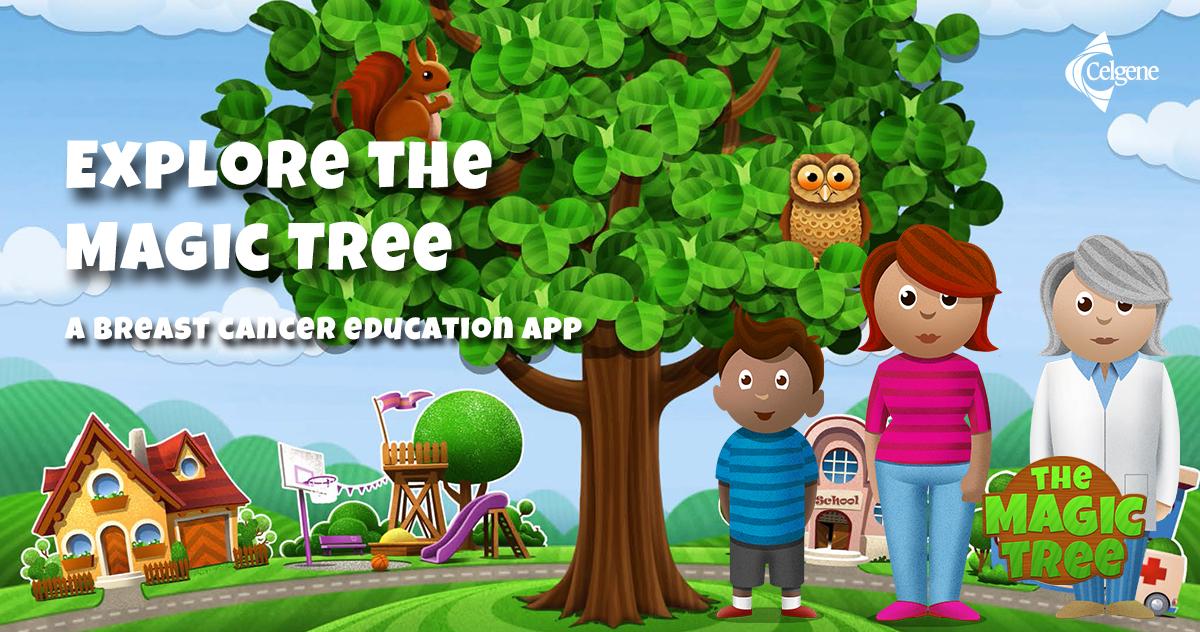


The app is aimed at children aged 5-8, so it would have probably missed the mark when Quinn was a toddler and could have benefited from a tool like this. I also noticed only traditional nuclear families are pictured, and it is only aimed at moms who get breast cancer (despite the fact that, while rare, men get breast cancer, too).

Even though I’m not in treatment for cancer anymore, I’m going to keep using The Magic Tree with Quinn to prompt our discussions of cancer, to help us both process what our family went through.

Wednesday, October 21, 2015

Hoping for the Two Percent

Ever since my breast cancer diagnosis, October has become a doozy of a month. I don't know if it's this way for everyone who goes through breast cancer, but I suspect it's tough for most of us who've been told our cancer has spread, that it's no longer considered curable.

It is hard to see the sea of pink -- in the seat-back pockets on my flight home from Missouri on Sunday, there was a flyer telling me I could buy a $2 pink lemonade to support breast cancer awareness. I wanted to scream about how aware I actually am. But Quinn was sleeping on my lap and an elderly woman was sitting beside me, on her way to help her daughter who'd just had hip surgery, so I kept my mouth shut. I raged on the inside.

It was even tough to watch Sunday football with my dad, and not just because the Seahawks keep freezing in the 4th quarter and losing games they should be winning. Pink goal posts and cleats and towels aren't contributing much to the cause they claim to support, and -- at best -- we inch toward better treatments, a few more months of survival (when the average after a mets diagnosis is 3 years), and if we're lucky, milder side effects.

All the while, the general population continues to believe that breast cancer is curable, we need to save the tatas, and early detection saves everyone.

I am exhausted, and it's okay if I blame October for that, right?

To me, this is the great injustice of this sea of pink, these calls to support awareness everywhere you look, most of it not doing much more than marketing products wrapped in pink. I used to think that both awareness and research were important. Now I wonder: Who is not aware?

But also, what do most people really know?

Breast Cancer Education Month doesn't really have the same ring to it.

According to the Story Half Told project I took part in, "Fifty percent of people surveyed said that breast cancer progresses because either patients did not take the right treatments or preventative measures." AND ALSO: "More than 60% say they know little to nothing about metastatic breast cancer." (emphasis mine)

*& %!)%#@!

A man I met a few years ago was saddened to tell me that his mom had beat breast cancer but couldn't beat brain cancer. My bet is that she never had brain cancer, but rather breast cancer that metastasized to her brain. She didn't die of brain cancer, she died of breast cancer. But I did not want to argue with a grieving son, so I simply told him I was sorry.

***

I try to be careful about the language I use. I no longer say I have metastatic breast cancer but rather that I was diagnosed with metastatic breast cancer more than four years ago. Do you see the difference? I don't know whether it changes anything and perhaps it's just superstition. I couldn't even bring myself to participate in a die-in (as proud as I am of the waves these women are making) because I don't want to say I'm dying of breast cancer -- even if 98% of people with this diagnosis do die of it. I have to hope I'll be part of the two percent.

Why does language matter so much? Why do we who've been diagnosed with metastatic breast cancer care whether you know what the word metastatic means?


Why are we over awareness?

We're really tired of our friends dying, for one. We're scared we will be next, even when we hope we'll live to see the next milestone: our child graduating, or getting married, or learning to tie his shoelaces.

I have nightmares about cancer, in the form of unwanted guests, or sharks trying to come onto shore to attack me, or burglars trying to break into my house, and I wake up sobbing and unable to relax enough to fall back asleep without the help of sleep aids.

We want people to understand how scared AND how hopeful we are, more than they will ever learn by purchasing a can of pink lemonade. We hope that one day these campaigns will go beyond awareness and actually do some educating so women (and men) will know their risk, understand what as many as 250,000 of us are living with every day, and maybe start turning some of the pink consumerism into research dollars that will help us have fewer nightmares and celebrate more milestones.

Instead of buying pink stuff this year, please consider donating to a reputable organization that provides money for research. Here are a few I like, in no particular order.

METAvivor.org -- the only organization solely focused on research into metastatic disease
BCRFcure.org -- funds the largest project focused on metastasis in the world; highest rated breast cancer charity in the U.S. according to Charity Watch
Avon Foundation -- contributes to critical research AND provides support services for under-served patient populations
Young Survival Coalition -- support for women diagnosed under the age of 40

Friday, December 5, 2014

Is All of This Perfectly Normal?

This last week has tested every bit of my patience with Quinn, and my patience has failed that test on more than one occasion. I have yelled (granted, there was either a hot glue gun or a dog lunging after our cat involved). I have taken toys away, placing them in a pile on our kitchen counter so Quinn could see exactly how many times he didn't listen to me that day. I have threatened to call Santa.

The thing is, I think I know what's going on. First my mom came to visit. Then my dad and his new wife were here visiting for a week over Thanksgiving, a week in which Quinn hardly went to preschool and was doted on and played with fairly nonstop ten to twelve hours a day. Then they left.

I do my best to play and play and play, but I also have meals to cook, laundry to fold, and a new dog to try to befriend to our cranky, panicky cat. I am no match for Grandma Sue or Grandpa and YaYa. Quinn has reacted pretty much the way he does when Chris leaves for Africa: petulant and ornery and just sort of perfectly three, a phase that typically lasts about a week post-departure.

Lately, if Chris or I ask Quinn to stop doing anything, his inevitable response starts with: "But I was just..." to the point where I told him that the word "just" wasn't allowed in our house any more. I will put a toy on the counter, so help me god.

There's a chance this all has nothing to do with our company leaving, and could just be Quinn picking up on our collective insanity this week -- the seemingly natural craze that comes with this time of year, with ordering holiday cards and shopping for gifts and Chris finishing up his semester at ASU and decorating and holiday parties and all of the STUFF. Not to mention the damn elf on the damn shelf. Also, we added a family member this week. It's a little nutso around here.

I've been waiting for my sweet boy (the one who isn't quite so cantankerous) to make a full-time appearance again. Then last night, he did, and it left me sobbing in bed next to him. We were lying down, talking about our day, our week, and how we'd both like to be better, to do better. I told him about all the things he does to make me proud: introducing himself ("I'm Quinn James Campisano, Quinn James Campisano, Quinn James Campisano...") to a new friend at swimming, being exceptionally sweet with our pets, and cleaning up his toys when it's time for dinner.

He asked to cuddle, then changed the subject somewhat abruptly.

"Mom, when I get older, I don't want to die."

"Honey, you don't have to worry about that for a long, long time." I stroked his hair off his forehead. After several identical interactions over the last week, though, I've started wondering if this is something we need to talk about more deeply. Where is this fear coming from?

Photo c/o Jennifer Bowen Photography

Is this normal 3-year-old stuff? I tried to explain that that's the beauty of this life, that we should enjoy it while we're here because eventually (a long, long time from now, we hope), we all have to stop living. 

"But dying means you're no longer here, and I don't want to go anywhere else," he insisted.

"Some people believe that when you die, you're reunited with your loved ones who've died before you." I tried.

"But I love you and daddy and Loki and Luna! The people in THIS house. I WANT TO STAY HERE." He was getting worked up.

"Honey, we're here right now, and that's what matters, right?" I hugged him a little tighter.

He continued. "When you die, what if we go different places? I don't want you to go anywhere. I don't want you to go away from me." And then I lost it. Usually I can hold back my tears in front of him, but not after that. The tears could not stop themselves. "Mommy, don't cry," he told me. 

I took a deep breath and pulled myself together. "Let's just stay here together as a family for as long as we can, okay buddy?" This seemed to satisfy him and alleviate his worries -- for last night, anyway. 

I did not know parenting was going to be this challenging. These conversations are not getting any easier. Have you talked to your children about death? Am I over-thinking this because of my own situation? Has cancer ruined my perspective? Is all of this perfectly normal? 

Monday, September 15, 2014

Are We Terminal?

When my friend Brigid died earlier this month, I found myself thinking a lot about my own mortality. (As these things go.) I've been living with advanced breast cancer for more than three years now, the last ten months in chemo-induced remission. But the average lifespan for someone with my illness is still twenty-six months. I've never thought of myself as terminal, but many people will describe this disease with that word. I began to wonder if I was just being wishful in my thinking.

I reached out to a group I belong to online, a support group for people with metastatic/stage 4 breast cancer to pose this query: Question for you all: how many of you think of yourselves as "terminal"? I don't know if I'm just a naive optimist or blindly mistaken but it's just never been a line of thinking I've been able to go down. After losing a (yet another) friend this week, I'm wondering if I've got blinders on.

I was surprised by the number of responses my post elicited. It received dozens of comments, mostly optimistic and all thought-provoking. I got permission to share a few of their comments here, to share their wisdom and the breadth of their experiences with all of you. These are the women who inspire me on a daily basis. You can see why.

(And if you want to donate to research for metastatic breast cancer, Metavivor is a great place to start.)

[photo credit]
***

I'll occasionally find myself saying in my head 'I have a terminal disease.' Honestly though, I'm not even sure what that means. I don't feel like I'm dying. My husband took a turn too fast on our motorbike a couple of days ago and we splayed out all over the road - I was definitely a lot closer to death then than I am now! Plus, most of my friends aren't even married yet. We're just starting to have acquaintances with kids. I can't be old enough to be terminal, so I'm just not, at least not right now. - Anonymous

I like to live in a healthy state of denial. I'm pretty sure I know what will kill me but I'm not dead today. So, I know the gravity of my situation but don't allow it to define me. It's a fine balancing act.....  I take it a scan at a time. I live in 3 month increments.... When that's too much, I take things a week at a time. Too much? A day at a time. Still too much? Take it an hour at a time. I get it. This isn't the life I had planned for myself or my family. But it's the life I was given. - Cristin

I've been NED for 7.5 years and still consider myself terminal. I think its because that's how it is "officially" classified. I just accepted it and mourned it and then as the years went by kind of just got on with it. I didn't think I'd make 40 and spent my $ like it too..lmao. I tell people it's terminal also to not minimize it but only when someone really probes. I also subscribe to the everyone is terminal mantra...I've had so many sudden losses and seen "well" people die while I'm still on one drug....so I know anything can happen to anybody at anytime. - Teresa

At least I have some idea of how I will die and what to expect (even though it sucks) and I can plan - I have already done my bucket list - and yes - some people will hate me for saying this but I feel lucky at the moment - it has me more in tune with others and what they are going through - it is important not to totally let it be only about YOU - I think more of others now. - Carter

I think of it as living with a dual awareness. I am completely aware that my disease is terminal but I think of myself as living with advanced cancer. Saying that, I do say 'I have terminal breast cancer' because I find for the most part people don't understand how serious it is and that I will never be cancer free. Right now I look well but that doesn't change the fact that I'm 99% sure I'm going to die young of breast cancer. - Anna

Not terminal right now. I'm in complete remission.... I think it makes women "feel" better if their cancer is one pathology over another. Or only in their bones versus their liver. It is like they are putting their hope that they might not die soon in the characteristics of their disease, when that is completely unpredictable. I personally prefer to put my hope in God who alone knows when I am going to die and trust that will happen in His good and perfect timing. - Roberta

I consider myself to be living with a chronic disease. Living with...not dying of cancer. Heart disease actually kills more woman than MBC [metastatic breast cancer]. That being said I'm pretty sure what will take my life...eventually. - Roxanne

I think of myself as living with cancer. When I go into hospice that will probably be when I consider being terminal. - Lori

I do refer to myself as terminal just to make a point to others, but the more drugs that aren't working the more discouraged I become. I do live each day to the fullest and enjoy every moment, but certain days I'm scared shit especially when tumor markers go up, scans show progression, horrifying side effects happen, etc. - MaryAnne

I subscribe to life is terminal, none of us are getting out of here alive. Every day is a blessing and I love life. Until they say sorry we can't do another thing and I agree, I am not terminal. If this is naive so be it! - Janie

I don't mean this in a downer way, more of in a Buddhist way. We're all terminal, dying. We don't know how or when. Life is fragile. Appreciate each moment, each day. - Laura

Never even thought of it as terminal. - Deborah

When I decide that it's time, then the life threatening part will take over, and there will be Hospice for me helping me to still live to the best of my ability until I actually die. I intend on being happy throughout this! - Mary

I'm so sorry about your friend. It is impossible at times to process all the losses..... I try to walk through yet wear them loosely, if that makes sense. To answer your question, no I don't think of myself as terminal at this time. I'm living with metastatic disease. Although it's in my stomach, lymph nodes and bones I'm still on the first course of therapy prescribed. I hope -- but can never be sure -- to have years between now and the time when I am terminal. Like all of you I live with that great uncertainty and most of the time it's ok. - Jody

I just never went down the road of "terminal"..... I always knew I would not die from Stage IV breast Cancer even when I was diagnosed with stage IV! I decided I would fight with everything in me and that started with positive thinking.....blinders - maybe. Whatever works. Six years later I am now NED! The doctors say I have far surpassed their hopes for each of my treatments.......I attribute it to my positive thinking, many prayers and yes my blinders or what I believe each and every one of us lives with to get through each day - a little bit of denial..... Healthy denial. - Serenity

I also don't consider it terminal like most of the ladies above me have commented. Life comes to an end at some point and it might be cancer that ends it or it might be a herd of unicorns stampeding over me. Life's tricky like that. I do try to explain to people that even though I am currently NED that I am not "cured," I will be on herceptin/perjeta for as long as they work and I might still have surgery and radiation coming up. Usually people don't understand which I'm coming to terms with. - Tricia

Friday, September 12, 2014

Around the Web

If I'd read nothing else on the internet this week, it would have been okay. The first article (below) alone would have been enough. Tomorrow is my thirty-sixth birthday, and this felt like a little bit of an early birthday present, even if it is only Phase 2 and still likely has a couple of years before FDA approval, assuming Phase 3 goes as well as this one did. There are a lot of ifs. But so many, many thank you's from the bottom of my heart to the researchers who are letting me celebrate more birthdays.

Vaccine for Her-2 Positive Breast Cancer Shows Promise

"Women with HER2 +3 who were administered trastuzumab [Herceptin] as part of the standard of care prior to receiving the vaccine experienced no cases of cancer recurrence."

Not from The Onion: Bras Don't Cause Breast Cancer

I can't believe someone got funded to study this.

Male Orangutan Dies of Breast Cancer

"Eli was diagnosed with breast cancer in 2011. Zoo veterinarians have monitored him closely since then, said spokeswoman Erica Hansen, in part because cancer is rare in orangutans. He was the only male known to have it, along with two females."

A Perspective on "Battle" Language

I am definitely guilty of personifying cancer. The name of my blog is Booby and the Beast, after all. I've talked about hunting down and eradicating cancer cells. I've compared chemo to smart-bombs. But I don't know that any of what I've done is brave, certainly not heroic. I'm just not sure how else to talk about living with cancer. I thought this post was excellent food for thought. 

"And I don’t want anyone at my funeral saying, “She fought bravely.” Because really, who doesn’t?"

But Speaking of Brave...

A teenager shares his cancer journey in pictures on Instagram.


Friday, August 29, 2014

Around the Web

{photo credit}
Here's what I found on the web this week. Every week, I hope it will be the cure, but I do believe we are getting closer. Let's just get there faster.

Is This Why Brain Mets Occur? Is This How We Can Stop Them?

"Now Memorial Sloan Kettering researchers have found that a protein called cathepsin S may play a key role in the spread of breast cancer to the brain. A complex interplay between breast cancer cells and certain surrounding cells called macrophages induces both cell types to secrete increased levels of cathepsin S, an enzyme that promotes the cancer cells’ ability to metastasize.

In addition to potentially helping doctors predict which breast cancer patients are at increased risk for brain metastasis, the discovery, published recently in Nature Cell Biology, suggests that cathepsin S could be an important target for new drugs."

Why We Need More Words to Describe Living with Cancer

What words do you use to describe your breast cancer journey? Battling? Thriving? Surviving? Suffering? Treating? All of the above? 

For the most part, I think to each her own when talking about cancer and otherwise, but I do think the author here is right: Amy Robach, by virtue of her position as a journalist, has a special responsibility to choose her words more carefully.

Public Service Announcement: Pfizer Initiates Expanded Access Program for Treating Certain Advanced Breast Cancers

"Under its expanded access programs, the U.S. Food and Drug Administration (FDA) works with companies to allow access to investigational therapies to patients with serious or life-threatening illnesses who do not otherwise qualify for participation in a clinical trial and for whom there are no comparable or satisfactory alternate therapies."

This particular drug, palbociclib, is for hormone-positive, HER-2-negative breast cancer patients.

Breast Cancer is Really (at Least) 10 Different Diseases

While it's inspirational to hear, "My aunt had breast cancer 10 years ago and is doing great now!" it probably doesn't have any bearing on how someone else diagnosed with breast cancer today is going to fare. As I keep reminding myself when I see my friends dying -- whose cancer is, on paper, very similar to my own -- every disease blueprint is unique.

How Much is a Cancer Drug Worth? The UK is Reevaluating.

"Big manufacturers set to be affected by the changes include Roche, which came under fire this month from Nice [National Institute for Health and Care Excellence] for failing to cut the price of Kadcyla. The £90,000 per course drug is for women with advanced breast cancer. Nice rejected the drug as failing to offer value for money at that price."

I am eternally grateful for the quality of my health insurance.

Friday, June 27, 2014

Around the Web

Here's what caught my attention around the web this week.

A paradigm shift.

I'm not sure I could fully adopt this woman's way of thinking, but I do think it's important to examine how we talk about disease. Are we battling? Are we warriors? Or are those of us diagnosed with cancer just doing the best we can with some shitty luck? 

One woman I know talks about shifting our thinking away from "fighting cancer" and more toward "creating health." Now that is an idea I can get behind. What about you? What words do you use to talk about cancer?

Why #BCSM is my favorite hashtag.

Most Monday nights, I'm not able to participate in the Tweet chat sessions accompanied by the #bcsm hashtag. But I still use it as a call signal when I'm feeling at my lowest, or when I have news to share, or when I want to talk to someone who knows exactly what it feels like to be buzzing on steroids at one in the morning. Someone always answers the call. If you haven't checked out the chats, you really, really should.

I wish her the absolute best. I pray chemo is as easy as possible for her. I hope she uses her platform as a celebrity and journalist to shed some light on this disease -- to educate, not just bring "awareness."

A possible new way to fight some breast cancers

"[Researchers] found that women were 4.4 times more likely to have a cancer recurrence during tamoxifen treatment when their main tumor had a high ratio (2:1 or greater) of androgen receptor-positive cells to estrogen receptor-positive cells."

The 3D news that was everywhere this week

When I was first diagnosed, I was asked to volunteer for a 3D mammogram to help further research into whether such tools were beneficial. I don't know if my own 45-minute, highly uncomfortable session added anything to this particular study, but I'd like to think I helped a little. Now if only they could figure out a way to PREVENT or CURE breast cancers, instead of just seeing them.

On that note, some researchers are looking at immunotherapy for treating metastatic breast cancer, thank you and amen.

This: "Unlike maintenance chemotherapy, with its associated cumulative toxicity, a therapeutic vaccine may offer clinical benefit with few adverse effects. The hope and promise is that women with MBC who mount an antibody response to a vaccine may experience significantly longer median survival and a better quality of life."

And, I just realized this article was from 2013, so here's hoping those scientists have made some significant progress since then! I'll see what I can find out for next week's round-up.

Sunday, May 12, 2013

Terminology

I have a bone to pick.

More and more often, I come across blogs, or Twitter posts, or Facebook status updates from or about women with Stage 4 breast cancer referring to it as terminal. And of course it is for some, but to me, terminal implies imminent death, not just incurable disease. For example, Parkinson's and diabetes are also incurable, and the people I know with those diseases don't characterize themselves as terminally ill.

My perspective on this has led me into some interesting discussions lately.

And it may be just semantics, but I think words matter. I have read the articles about how mindful we must be with our language describing how we approach this disease. Are we warriors in battle? If someone loses their fight, does that imply they somehow weren't strong enough? Language is powerful. And we should choose our words carefully so that we honor all of us who are afflicted with this damn disease, however each of us chooses to go up against it.

In my mind, we have to be just as careful about how we categorize ourselves, even when handed a devastating diagnosis. Yes, being Stage 4 is scary: The doctors visits never end, the world of treatments and scans and having an ugly port in your chest are ever present, and there is always the fear of What if treatment stops working? lurking closer to the surface of your brain than you'd like.

And while the statistics are somewhat shitty for those of us with advanced breast cancer, the latest statistics are at least three years old. This means they don't tell the story of medicines that have been approved in the last couple of years, so they cannot incorporate current medical protocol. They don't tell the story of any one individual, because statistics cannot do that, either. What statistics do is group together everyone who's diagnosed with Stage 4 breast cancer, whether they are 26 or 62 at initial diagnosis, whether they are obese or fit, whether their breast cancer is inflammatory or HER-2 positive or triple negative, whether their scans show a few hotspots in their lymphatic system or significant organ involvement.

I'm not trying to trivialize my illness here. I realize (God, do I realize) that too many people still die of breast cancer--about 40,000 will this year in the U.S. alone. Forty thousand. For every single one of them, this disease is terminal.

However, for many of us--for more and more of us as advances in science are made--a Stage 4 diagnosis does not equal an automatic death sentence. As my doctors--some of the best in the country in this field--have said, in many cases advanced breast cancer can be a chronic condition, maybe not curable, but treatable and manageable long-term. This idea, that what I have is a chronic rather than terminal disease, gives me comfort.

Perhaps I'm being naive or ignoring the 900-pound gorilla in the room here, but there is not a day that goes by that I don't think about cancer, so I don't think I'm taking an all rainbows and unicorns approach here.

I have another scan this week. I am all-too-aware of the implications of my diagnosis. I start to imagine the what-ifs, and my heart hurts. In line at the post office the other day, a mom and her two teenagers were flipping through their passport photos, joking about what terrible pictures they'd all taken, ribbing each other for having lopsided smiles or looking tired. And I started crying, right there in the damn post office line, because I had a fleeting thought wondering whether I'd get to plan trips that require a passport with my teenager someday.

Which is why I think it's even more important to inject some hope into the terminology we use to describe this godawful disease.

Under the Americans with Disabilities Act, to qualify for protections under the law, to be considered disabled for legal purposes due to cancer, you have to show that the disease has interfered with a major life function. Menopause--even chemically-induced, twenty-years-earlier-than-you'd-planned-it menopause--doesn't count. (Clearly, men wrote this law). As it stands today, I'm not sure I could qualify for a handicapped sticker on my car. To me, then, it seems--at best--disingenuous to call my disease terminal. At worst, I think I'd be tempting fate.

Call this disease many things. Call it the devil and a thief. Get out your best potty mouth and call it all sorts of ugly names you'd be embarrassed to say around your grandmother. But unless your doctor has given you a time stamp (and even then, still consider being careful with your words), please don't call this disease terminal. Not for this Stage 4 girl.