
Whatever the reason, I haven't found time (or words) to write lately.
But the publicist appealed to the mom in me. The synopsis she sent promised the story of a mom diagnosed with metastatic cancer who experiences nothing short of a medical miracle. More than anything, I wanted to read A Series of Catastrophes & Miracles because who doesn't love a good miracle? Isn't it what we all hope for? So I said yes and received my copy in the mail a few weeks ago.
From the opening "Spoiler: I lived.", I was hooked. I freaking devoured this book. So if you're looking for a more balanced review, you may want to look elsewhere. I'll be over here re-reading my copy a few more times. You should go get your own.
As a stage 4 cancer patient, of course I could relate to so many of Ms. Williams' experiences -- MRIs and PET/CT scans, learning the language of cancer, facing your mortality far younger than you ever expected, even dealing with scars because your body has been carved up in an attempt to rid you of the disease that might kill you. "I do what I can to cover my scar, so the sun won't burn more cancer around the part of my scalp the doctors removed--and also because I don't want my freakishness to make people uncomfortable. And by people, I mostly mean my own children," Ms. Williams writes. She is witty and snarky and reminds me of some of my best friends.
So many times in the book, I wished I could sit down with her over coffee and scones -- or a glass of wine -- to say, "Me, too. I've been there." I've lost too many friends. I've marveled at my response to treatment when others whose disease seems the same on paper don't fare as well. "This is the cruel reality of successful cancer treatment. You want so much for everybody to get what you got, and for it to work like it did on you, but that's not how it happens. Instead, getting better often feels as random as getting sick was," she says.
I wanted to give Ms. Williams a high-five and a hug for lauding the scientists who hand her her miracle. She writes, "And just to be perfectly clear on this point in case somehow you missed it--I didn't get better because I prayed correctly or because I'm strong. I got better because the science worked on me." A-freaking-men. The author's calls for more research -- because sometimes it works! -- are woven throughout the narrative, and I hope above all this book spurs a loud public cry for science funding increases.
As a stage 4 cancer patient, of course I could relate to so many of Ms. Williams' experiences -- MRIs and PET/CT scans, learning the language of cancer, facing your mortality far younger than you ever expected, even dealing with scars because your body has been carved up in an attempt to rid you of the disease that might kill you. "I do what I can to cover my scar, so the sun won't burn more cancer around the part of my scalp the doctors removed--and also because I don't want my freakishness to make people uncomfortable. And by people, I mostly mean my own children," Ms. Williams writes. She is witty and snarky and reminds me of some of my best friends.
So many times in the book, I wished I could sit down with her over coffee and scones -- or a glass of wine -- to say, "Me, too. I've been there." I've lost too many friends. I've marveled at my response to treatment when others whose disease seems the same on paper don't fare as well. "This is the cruel reality of successful cancer treatment. You want so much for everybody to get what you got, and for it to work like it did on you, but that's not how it happens. Instead, getting better often feels as random as getting sick was," she says.
I wanted to give Ms. Williams a high-five and a hug for lauding the scientists who hand her her miracle. She writes, "And just to be perfectly clear on this point in case somehow you missed it--I didn't get better because I prayed correctly or because I'm strong. I got better because the science worked on me." A-freaking-men. The author's calls for more research -- because sometimes it works! -- are woven throughout the narrative, and I hope above all this book spurs a loud public cry for science funding increases.
As a wife who's watched my husband lose both his parents, there were uncanny parallels in Ms. Williams' story and my own. Through the difficulties of loss, and how a marriage can contain enormous grief yet still find space for enduring love, I found myself wanting to underline and highlight entire chapters. "Yes, this. And also this," I kept thinking, often through tears.
And as a mom, I could also relate. In one passage, Ms. Williams writes, "When I walk in the door at last, the first thing I do is the first thing I always do when I get in late. I peek in on the girls and their dreaming forms. Sometimes, when I look at them, I see the babies they once were, all flushed and milk drunk in my arms, their chubby hands curled around my finger. I remember them pulling up to standing in the crib, then plopping down on unsteady legs with surprised giggles. Other times, I look at them and see two young women, a bride and her maid of honor at a wedding, or two grubby travelers throwing down backpacks in the hall after a month hiking Central America together. I want to be there, I think, as I watch them from the doorway, for all of it."
I put the book down then, got out of bed to go check on Quinn, and listened to the sound of his rhythmic nighttime breathing. I know this mom. I know this love. I want to be there for all of it, too. Here's to more miracles.
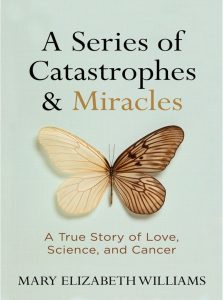
About A Series of Catastrophes and Miracles
• Hardcover: 304 pages • Publisher: National Geographic; 1 edition (April 26, 2016) A wry, witty account of what it is like to face death—and be restored to life. After being diagnosed in her early 40s with metastatic melanoma—a "rapidly fatal" form of cancer—journalist and mother of two Mary Elizabeth Williams finds herself in a race against the clock. She takes a once-in-a-lifetime chance and joins a clinical trial for immunotherapy, a revolutionary drug regimen that trains the body to vanquish malignant cells. Astonishingly, her cancer disappears entirely in just a few weeks. But at the same time, her best friend embarks on a cancer journey of her own—with very different results. Williams's experiences as a patient and a medical test subject reveal with stark honesty what it takes to weather disease, the extraordinary new developments that are rewriting the rules of science—and the healing power of human connection.
Purchase Links